NL2REGEX: Distributed Regex Engine
- Reading
- 172 backend tests · ADR 0004 pays JVM startup once per worker, not per task
- Datum
- Ravicha2/NL2REGEX. tests_regex_safety.py#L16-L26 @ 9c9fe8a
- Verdict
- Measured · holds
Distributed Natural Language to Regex Engine for Large-Scale Datasets
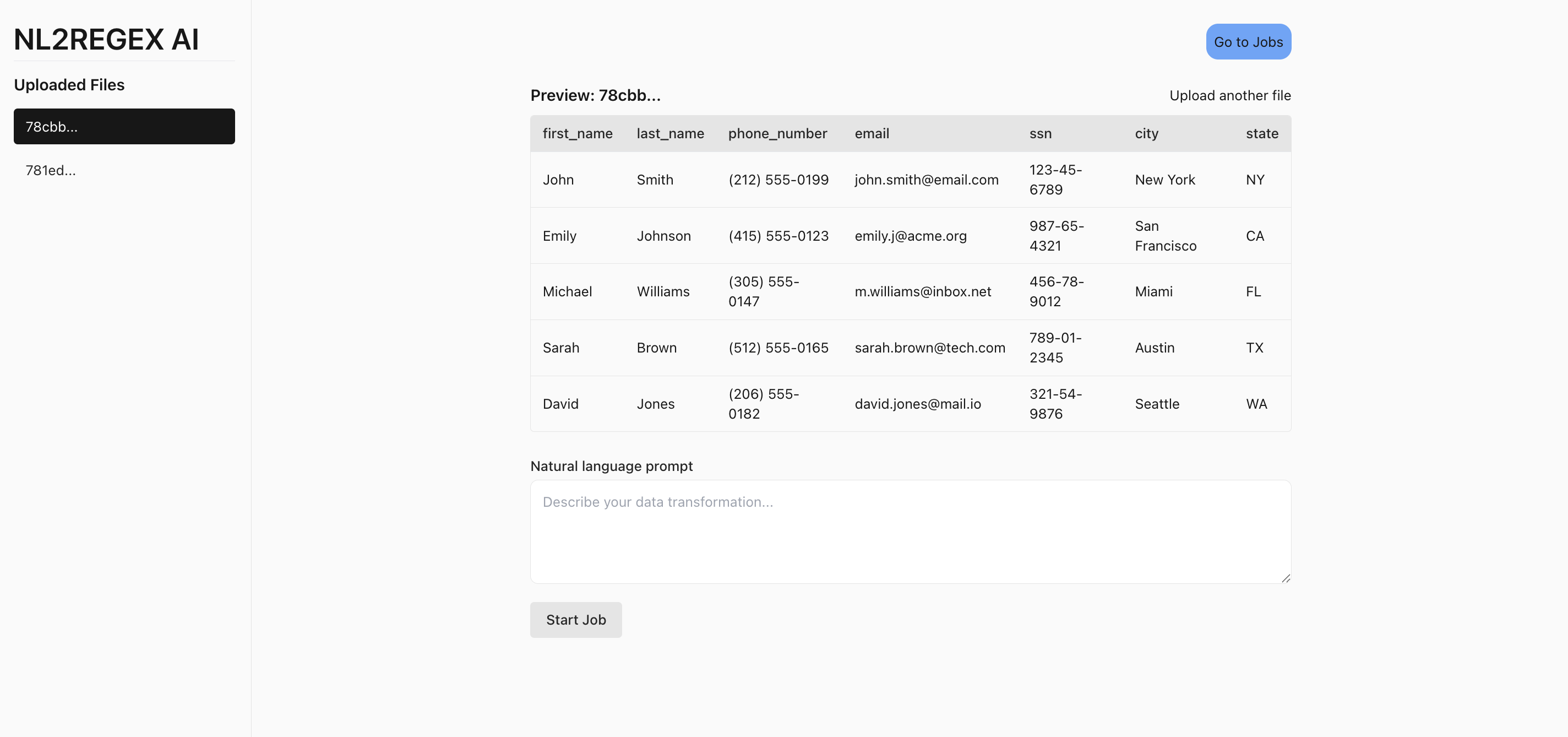
Distributed natural language to regex engine that transforms complex tabular dataset patterns using plain English, backed by PySpark and Celery with schema-validated triage.
- Role
- Creator / Full-Stack Engineer
- Timeline
- 2026
- Subject
- Distributed Systems
- 172 cases
- backend tests over the API, Spark projection, Parquet normalization, and ReDoS safety
- 3–5 s
- Spark JVM startup per task avoided by the singleton session
- PySpark 3.5
- Django 5
- Celery
- Redis
- PostgreSQL
- React 18
- Docker Compose
Source, as quoted
Ravicha2/NL2REGEX9c9fe8aL16–L26
The ReDoS sandbox is load-bearing, not decorative: both catastrophic-backtracking patterns raise instead of hanging the worker.
    def test_catastrophic_backtracking_regex_times_out(self):
        # (a+)+b on all-'a' string forces exponential backtracking (no 'b' to match)
        pattern = r"(a+)+b"
        with self.assertRaises(RegexSafetyError):
            LLMRegexService.validate_regex_safety(pattern)

    def test_nested_quantifier_backtracking(self):
        # Another pathological pattern: (a|a)* on repeated 'a's
        pattern = r"(a|a)*b"
        with self.assertRaises(RegexSafetyError):
LLMRegexService.validate_regex_safety(pattern)Core intuition & friction
Enable safe, scalable natural-language data transformation without transmitting raw dataset records to LLMs.
The spark and the initial hypothesis
The naive failure mode
The root problem encountered
Schema hallucination, ReDoS lockups, and memory exhaustion when scaling naive LLM data transformations.
- LLMs inventing column names not present in uploaded CSV headers (Schema Hallucination)
- Generated regexes triggering catastrophic backtracking (ReDoS) and freezing Celery worker threads indefinitely
- Multi-gigabyte file uploads causing out-of-memory (OOM) crashes in pandas workers
- Zero upload of dataset records to LLM APIs (privacy constraint)
- Worker stability under concurrent multi-user transformations on large datasets
Why built this way
Key architectural insight
Two-Stage LLM Triage
vs Single-prompt end-to-end generationStage 1 validates target columns and transformation intent against verified schema headers; Stage 2 generates and validates regex syntax. Eliminates hallucinated columns.
Canonical Parquet Normalization (ADR 0002)
vs In-memory Pandas DataFramesUploaded CSVs are immediately converted to partitioned Parquet files, allowing PySpark to execute regex projections in parallel across partitions.
Local Singleton JVM Session (ADR 0004)
vs Per-task Spark session creationCelery worker processes share a persistent PySpark JVM instance, eliminating multi-second SparkSession initialization latency.
Guardrails and defensive design
- Regex pre-compilation wrapped in POSIX signal.alarm timeout sandbox to prevent ReDoS
- SHA-256 prompt hash caching in Redis to prevent redundant LLM invocations
- Strict Pydantic payload validation on all Celery task inputs
Outcomes & verification
Verification benchmarks
- 172-test backend suite covering the API surface, Spark projection, Parquet normalization, pagination, and ReDoS-safety cases
- Validated regex execution safety against known ReDoS malicious payload benchmarks
Real-world impact
- Lets non-technical users transform large tabular datasets without writing regex or moving records to a cloud LLM.
- Documented in 5 architectural decision records (ADRs) covering LLM triage, Parquet normalization, and the PySpark session strategy.
Core engineering takeaway
Get in touch
Master of IT at UNSW Sydney (WAM 83 / Distinction, graduating Dec 2026) · Open to full-time Applied AI & Backend Systems roles.