Fault-Tolerant Document Ingestion Agent
- Reading
- 8 durable steps / 4 worker functions · each stage retries alone
- Datum
- Ravicha2/document-ingestion-agent. ingestion.ts#L24-L70 @ a698cbf
- Verdict
- Measured · holds
Event-Driven AI Document Ingestion with Durable Orchestration
Production-grade event-driven AI ingestion engine using Inngest durable steps, NestJS, and dual pgvector/Neo4j storage to eliminate orphaned state during multi-stage document processing.
- Role
- Backend Engineer Intern (NodesNow LLC)
- Timeline
- Dec 2025 - Feb 2026
- Subject
- Agentic AI & MCP
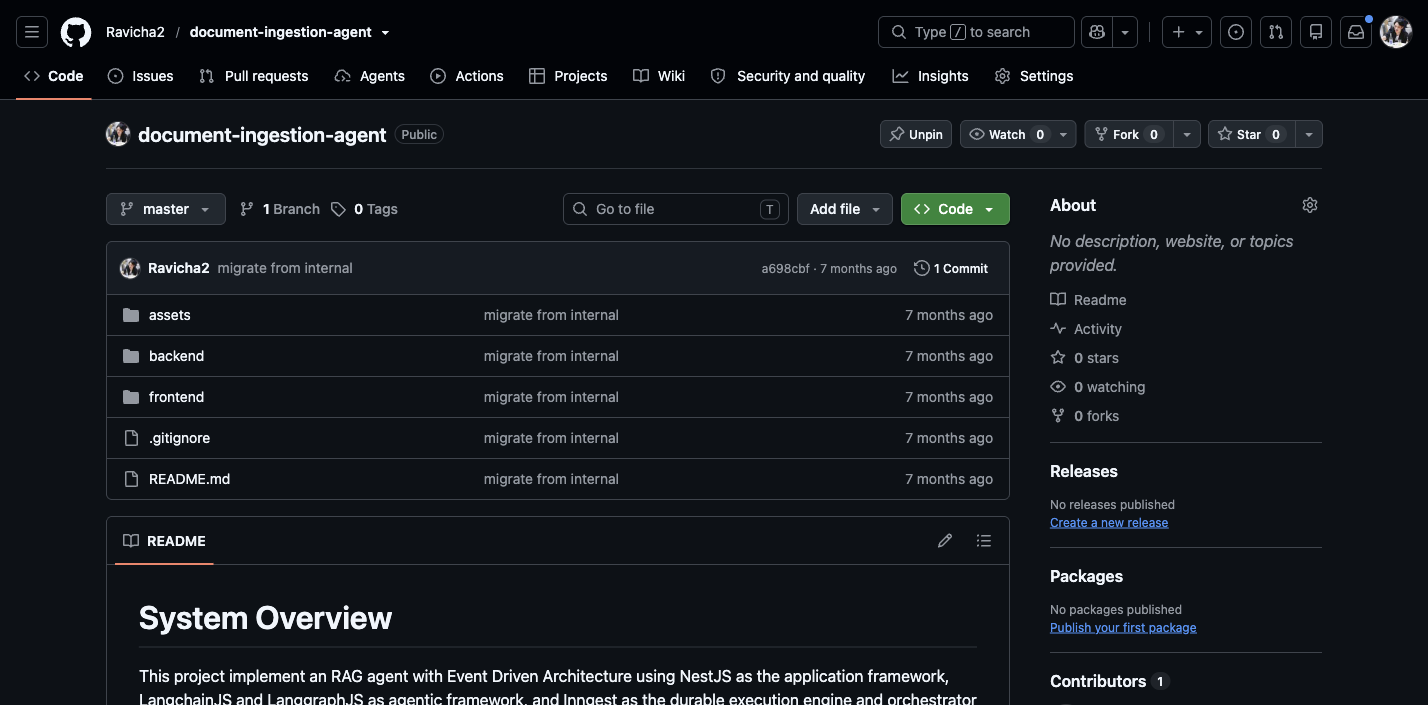
Ravicha2/document-ingestion-agent
- 8
- durable Inngest steps across 4 worker functions, each retryable on its own
- 2 stores
- pgvector embeddings and Neo4j graph entities, written per step
- Inngest
- NestJS
- Neo4j
- pgvector
- PostgreSQL
- React
- Docker
- TypeScript
Durable run, in order
Ravicha2/document-ingestion-agenta698cbfL24–L70
Every stage is its own durable step, so a failure at one resumes there rather than restarting the run.
- 01extract-chunksdocument-ingestion-agent#L24
- 02save-initial-chunksdocument-ingestion-agent#L40
- 03dispatch-parallel-jobs ⇢document-ingestion-agent#L70
Core intuition & friction
Achieve fault-tolerant, resumable document processing where failure at any stage recovers automatically.
The spark and the initial hypothesis
The naive failure mode
The root problem encountered
Orphaned database state and high re-computation costs when long-running AI pipelines fail midway.
- API rate limiting during parallel embedding generation
- Partial writes leaving vector embeddings in pgvector without corresponding nodes in Neo4j
- Inconsistent state from concurrent uploads of identical document revisions
- Zero manual database cleanup required after transient external API outages
- Full pipeline idempotency across all processing steps
Why built this way
Key architectural insight
Inngest Durable Orchestration vs Traditional Message Queues
vs BullMQ / Celery standard queuesInngest preserves intermediate step state in persistent storage. If step 4 (Graph ingestion) fails, only step 4 is retried, saving expensive LLM API tokens already spent in steps 1-3.
Dual-Layer Persistence (pgvector + Neo4j)
vs Vector-only storageVector embeddings enable fast semantic similarity search, while Neo4j property graphs enable relational reasoning across extracted entities.
Guardrails and defensive design
- Idempotency keys on every ingestion job based on document content hash
- Exponential backoff with jitter on all LLM and vector store network calls
- Transactional rollback handlers for failed graph node insertions
Outcomes & verification
Verification benchmarks
- Eight durable steps across four Inngest worker functions, each checkpointed and retryable with exponential backoff, so a failure resumes at the failed step rather than the start.
- Containerized full stack (NestJS, Inngest server, Neo4j, pgvector) with Docker Compose for automated CI test suites.
Real-world impact
- Removes manual engineer intervention on ingestion pipeline failures.
- Enabled hybrid RAG search combining semantic vector similarity with multi-hop knowledge graph queries.
Core engineering takeaway
Get in touch
Master of IT at UNSW Sydney (WAM 83 / Distinction, graduating Dec 2026) · Open to full-time Applied AI & Backend Systems roles.